Can a paw print help with grief? An honest answer
A paw print can't take grief away, but many people find it gives their loss somewhere to rest: something real to hold, a shape they recognize, a reason to say their pet's name. That's worth having, as long as nobody expects it to do more than it can. Grief after a pet is often stronger than people expect: 66.9%[1] of RSPCA survey respondents were surprised by its intensity.
By the Paw Print Keepsakes & Memorial Impressions editorial team · Updated September 24, 2026 · 4 min read · Sources
- Why touch and familiar shapes matter in early grief
- What a print can't do, and why that's fine
- Free support lines if you need more than a keepsake
The short answer
Does keeping a paw print actually help?
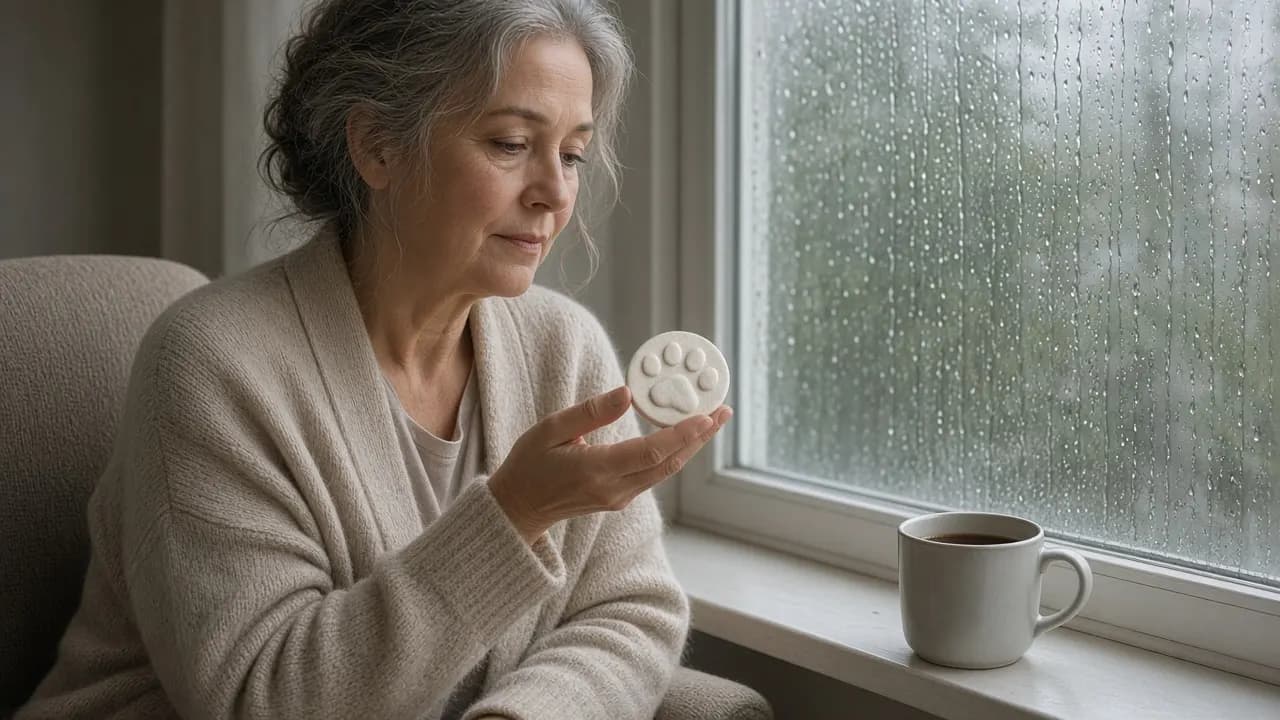
For many people, yes, a little, and in a specific way. A print gives grief something concrete. You can hold it, see the shape of the toes you used to dry after walks, and put it somewhere that becomes a small place to stop. That's comfort, not a cure. The sadness is still there; the print simply gives it a focus.
It won't help everyone equally, and it doesn't need to. Some people find a print too painful at first and put it away for months. Others carry a pendant copy every day. Both are normal ways of keeping a bond with an animal who mattered. Where other readers keep their prints, from drawers to pendants, is on the poll results page.
Where would your pet's print live?
Tap an answer to vote and see how others answered. Anonymous.
Why it feels different
Why does a print feel different from a photo?
A photo shows how your pet looked. A print is a trace of your pet: the actual pressure of their paw, at the actual size. People describe recognizing it instantly, the splayed toe on one side, the pad that was a little bigger, in a way they don't with a picture. It's physical evidence that this particular animal lived in your home.
That matters because pet grief is often lonely. In the RSPCA's survey of more than 4,000 bereaved owners, 57.1%[2] felt they had to hide their grief, and 56.7%[3] couldn't find the support they needed. A print on a shelf is a quiet, private acknowledgement that the loss is real, even on days when you haven't told anyone how you feel.
Before the loss
Can taking a print before your pet dies help?
Often, yes. Grief frequently starts before death: 75.4%[4] of RSPCA respondents experienced anticipatory grief, the heavy sadness of knowing a loss is coming. That period can feel helpless. Taking a print is one of the few things you can actively do, with your pet still warm and alive beside you, and it tends to be a calmer memory than anything arranged on the final day.
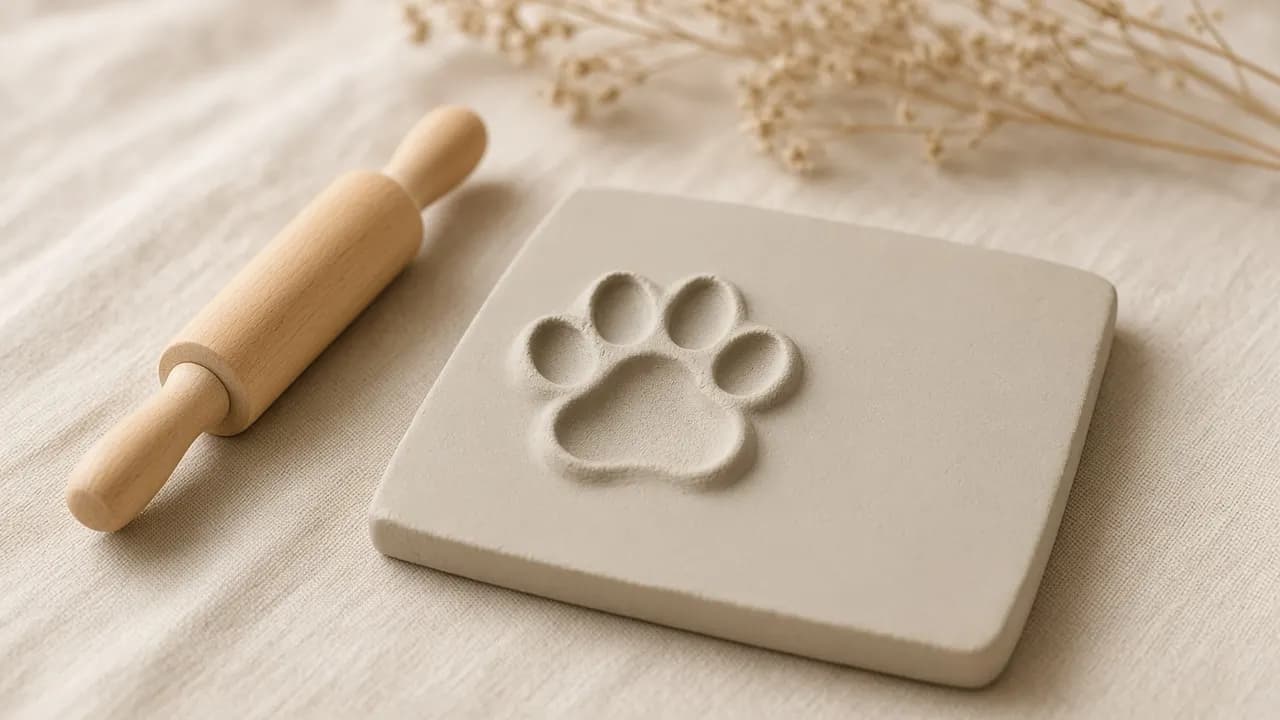
There's a practical side too. A living, relaxed pet gives a much clearer print, and you can try again if the first one smudges. Our print window timing guide explains when to plan it, and the paw print kit chooser helps you pick a kit.
Free tool
Paw print keepsake chooser
Match a print method to your pet's size, fur and the keepsake you want to keep.
Honest limits
What can't a paw print do?
It can't shorten grief, and it can't replace support from people. Grief after a pet can be serious: a 2026 UK study found 7.5%[5] of people bereaved of a pet met the criteria for prolonged grief disorder. For those people, no keepsake is enough on its own. Applied to US pet cremations, our rough estimate is ~112,500 people/yr[6] who may go on to meet those criteria, which is why support lines matter.
It also shouldn't become a source of guilt. If the print didn't happen, or it came out blurry, or you can't bear to look at it yet, none of that says anything about how much you loved your pet. Our list of paw print keepsake ideas includes options that work from photos, for anyone who missed the chance.
How closeness shapes it
Why does losing a pet hurt as much as it does?
One research finding stands out: how close you were matters far more than the species. A study in the journal Death Studies found that closeness to the one who died was overwhelmingly the strongest predictor of grief severity, whether the loss was a person or a pet[9]. And in one market survey, 40%[10] of owners said their grief after a pet's death equaled or exceeded grief after a human loss. Harvard Health has a readable summary of why losing a pet can hurt as much as losing a person.
Seen that way, keeping a print is ordinary, not sentimental excess. People keep a parent's handwriting or a child's first shoes for the same reason. The paw was part of a daily relationship: walks, feet on the sofa, a paw on your arm asking for breakfast.
Keeping a print isn't holding on too tightly. It's holding on to the right thing.
Living with it
How do people actually use a paw print in the months after?
Some ways families describe using a print, none of them right or wrong:
- Keeping it in a drawer for the first weeks, then moving it to a shelf.
- Touching it when leaving the house, the way they used to say goodbye.
- Bringing it out on the anniversary, or on the pet's birthday.
- Having a copy engraved on a pendant to carry on hard days.
- Sharing scanned copies with family, so everyone has one.
If several people want something to keep, a small amount of ashes can go into keepsakes as well; the ashes sharing planner shows how far they go. Our guide to displaying prints and pairing tags has ideas for where a print can live, and our services page explains who can make copies. If you'd like help finding someone local to take or finish a print, send us a note. Our local pages list makers by city.

Free tool
Ashes sharing planner
Split ashes fairly between family members, keepsake urns and jewelry.

Reader polls
What would you choose?
Vote anonymously and see how other readers answered. The results are live counts from people who visit this site, so they show real opinions, not a scientific sample.
Where would your pet's print live?
Tap an answer to vote and see how others answered. Anonymous.
What helped you most in the first weeks?
Tap an answer to vote and see how others answered. Anonymous.
What was the hardest part of losing your pet?
Tap an answer to vote and see how others answered. Anonymous.

Questions people ask
Is it normal to cry every time I look at my pet's paw print?
Yes. In the early weeks, a print often brings grief to the surface, because it's such a direct reminder. For many people that eases over months, and the print gradually becomes more comforting than painful. If it's too much right now, put it somewhere safe and out of sight and come back to it when you're ready.
Should I take a paw print if I think it will upset me?
You can take it and decide later whether to look at it. Many people who hesitated are glad afterwards that it exists, even if it stays in a drawer for a while. If you'd rather not take it yourself, a vet or crematory can do it, so you don't have to be involved in the moment.
Can a paw print help children grieve?
It can give children something concrete to hold and a way to talk about their pet. Letting them help decorate or choose where the print goes often helps more than simply showing it to them. Be honest that the print is a way to remember, not something that will stop them feeling sad.
What if I didn't get a paw print and feel guilty?
That guilt is very common and very undeserved. Many losses are sudden, and few people are told prints are possible. A clear photo of a paw or nose can still be turned into an engraving or a drawing, and other keepsakes such as a collar or fur clipping carry just as much meaning.
Where can I get help if grief is overwhelming?
Free pet-loss support lines exist, including Tufts University's and Cornell's helplines in the US and Blue Cross's service in the UK. Your doctor can also help, particularly if grief is affecting sleep, work or eating for weeks. A keepsake can comfort, but it's not a substitute for talking to someone.


Sources and our estimates
- [1] 66.9% of respondents were surprised by how intense their grief was after losing a pet. RSPCA — Pet Loss Survey Results, 2026.
- [2] 57.1% felt they had to hide their grief after a pet died, and 57.8% perceive stigma around pet loss. RSPCA — Pet Loss Survey Results, 2026.
- [3] 56.7% of bereaved pet owners in the RSPCA survey could not find the support they needed. RSPCA — Pet Loss Survey Results, 2026.
- [4] 75.4% of RSPCA pet-loss survey respondents experienced anticipatory grief before their pet died. RSPCA — Pet Loss Survey Results, 2026.
- [5] 7.5% of UK adults whose bereavement was the death of a pet met criteria for prolonged grief disorder (PGD). Hyland et al., 'No pets allowed: Evidence that prolonged grief disorder can occur following the death of a pet', PLOS ONE (2026), 2026.
- [6] Each year about 110,000 U.S. pet owners may go on to meet prolonged grief disorder criteria after a pet dies. Our estimate: 1.5M pet cremations (proxy for pet deaths with an engaged owner) x 7.5% PGD rate. How we calculate.
- [7] Tufts University's Pet Loss Support Helpline (508-839-7966) is free and volunteer-staffed, 6–9 pm ET Monday to Thursday, with 24-hour voicemail. Tufts Cummings School of Veterinary Medicine, 2026.
- [8] Blue Cross's Pet Bereavement Support Service in the UK is a free, confidential phone and email helpline open 365 days a year. Wikipedia – Blue Cross (animal charity), 2026.
- [9] A Death Studies paper comparing pet and human loss found closeness to the deceased was overwhelmingly the strongest predictor of grief severity, whatever the species. Europe PMC abstract — Eckerd, Barnett & Jett-Dias, 'Grief following pet and human loss: Closeness is key', Death Studies (2016), doi:10.1080/07481187.2016.1139014, 2016.
- [10] Mordor Intelligence reports that 40% of owners say their grief after a pet's death equals or exceeds grief after a human loss. Mordor Intelligence — Pet Funeral Services Market report page, 2025.
Find a print or keepsake maker near you
Tell us what you need and where you are. We'll reply by email with clear options and prices so you can decide in your own time.