Making a paw print with children: gentle roles for every age
Children can absolutely help make a paw print, as long as the job fits their age and saying no is a real option. In an RSPCA survey, 93.4%[1] of parents wanted better guidance on helping children through pet loss, so here is a practical plan for the print itself.
By the Paw Print Keepsakes & Memorial Impressions editorial team · Updated September 24, 2026 · 5 min read · Sources
- Jobs a toddler, a ten-year-old and a teenager can each do
- Pet-safe materials and the one craft recipe to avoid
- Words that help, and when to keep it simple
The short answer
Should children help make a pet's paw print?
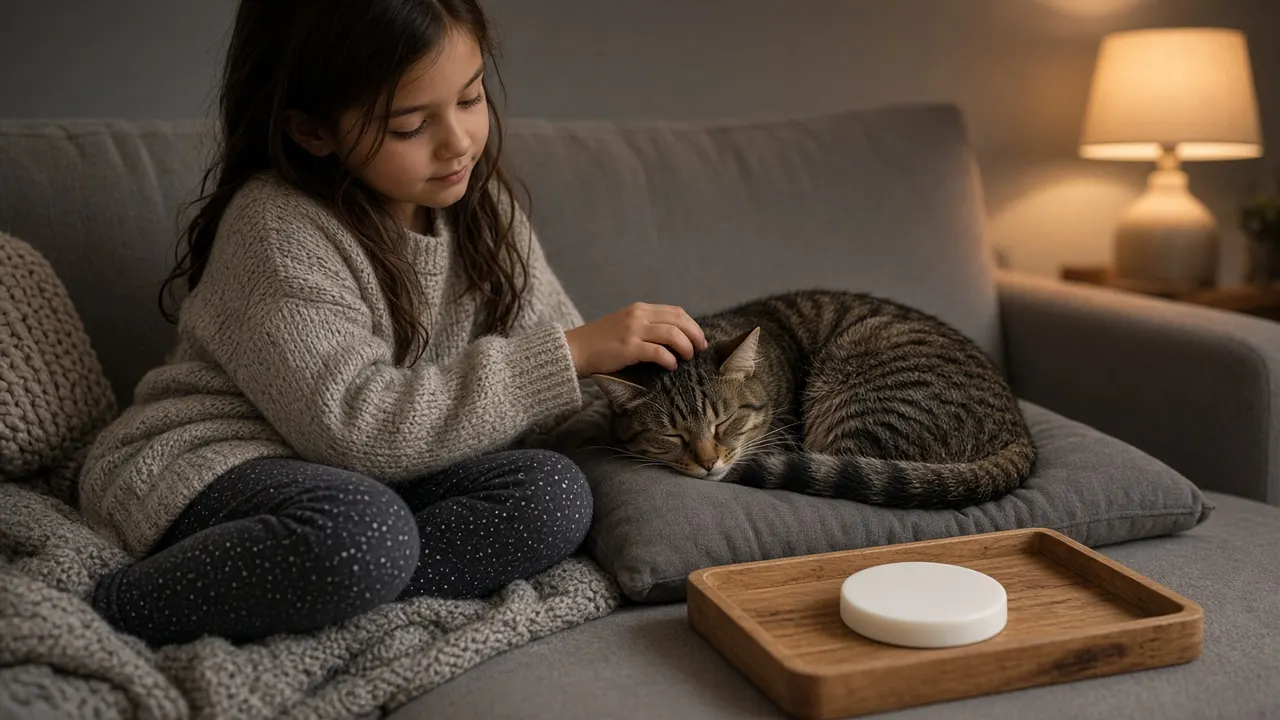
Yes, if they want to and the job is sized to them. Most children cope well with small, concrete tasks: holding the card still, choosing the ribbon, writing the pet's name. What upsets them is being surprised, rushed or made to watch something they didn't expect. So explain what will happen in a sentence or two, offer a role, and make it clear that watching from the doorway is fine too.
Children feel these losses deeply because they see the pet as part of the family, just as adults do. In the RSPCA's pet-loss survey, 99.3%[2] of respondents saw their pet as family, a friend or a companion. A print session is one of the few moments where a child can do something with their love rather than simply be told about the loss. Deep grief for a pet isn't unusual in adults either: by our estimate, up to about 1 in 15 UK adults[3] may have had a pet's death hit harder than any human loss. The poll results show how many families make a copy of the print for each child.
How many copies of the print would your family want?
Tap an answer to vote and see how others answered. Anonymous.
Age by age
Which jobs suit which age?
Match the job to what the child can do with steady hands and a steady heart. These are starting points, not rules; you know your child.
| Age | Good jobs | Probably skip |
|---|---|---|
| 2 to 4 | Pat the pet, pass the towel, press their own hand in spare clay | Holding the paw, anything with scissors |
| 5 to 7 | Hold the card still, choose the ribbon, stamp stars around the edge | Pressing the paw, trimming fur |
| 8 to 12 | Help steady the pet, write the name and date, photograph the result | Doing the print alone |
| 13 and up | Take the print with an adult, scan it, choose copies for relatives | Only what they say no to |
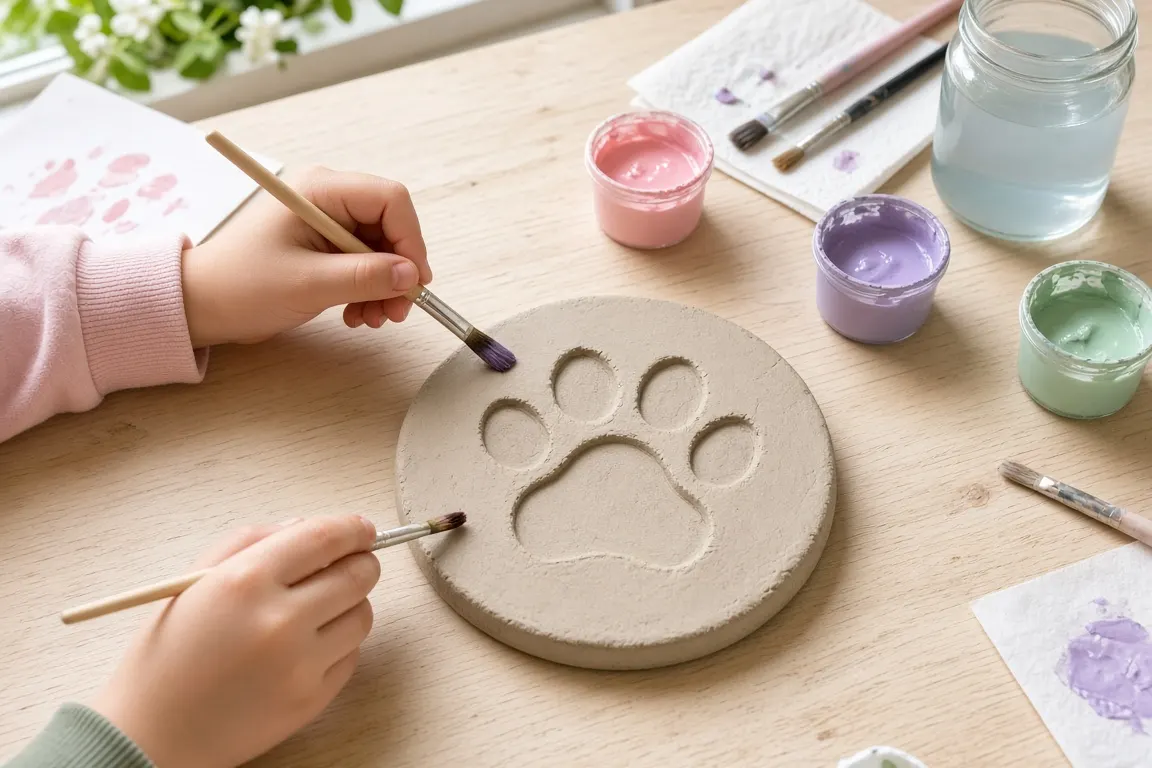
Younger children often love having their own handprint next to the pet's. It gives them something to do with their hands, and it turns the disc into a picture of the relationship, not just the paw.
When to do it
Is it better to make the print before or after the pet dies?
With children, earlier is kinder. Adults usually feel the loss coming well before it arrives: 75.4%[4] of RSPCA survey respondents grieved before their pet died, and children pick up on that tension even when nobody explains it. A print made on an ordinary weekend, while the dog is snoring on the rug or the cat is purring in a lap, is a happy memory in itself. Children can laugh when the dog licks the clay, and nobody is trying to hold back tears at the same time.
If the pet is already very ill, a print a few days before the goodbye still works well, especially if you explain it as a way to keep their paw forever. After death, most parents do the print themselves and let children join in with decorating or naming afterwards. Our print window timing guide explains what's possible at each stage.
Safety
What materials are safe when children and pets are both helping?
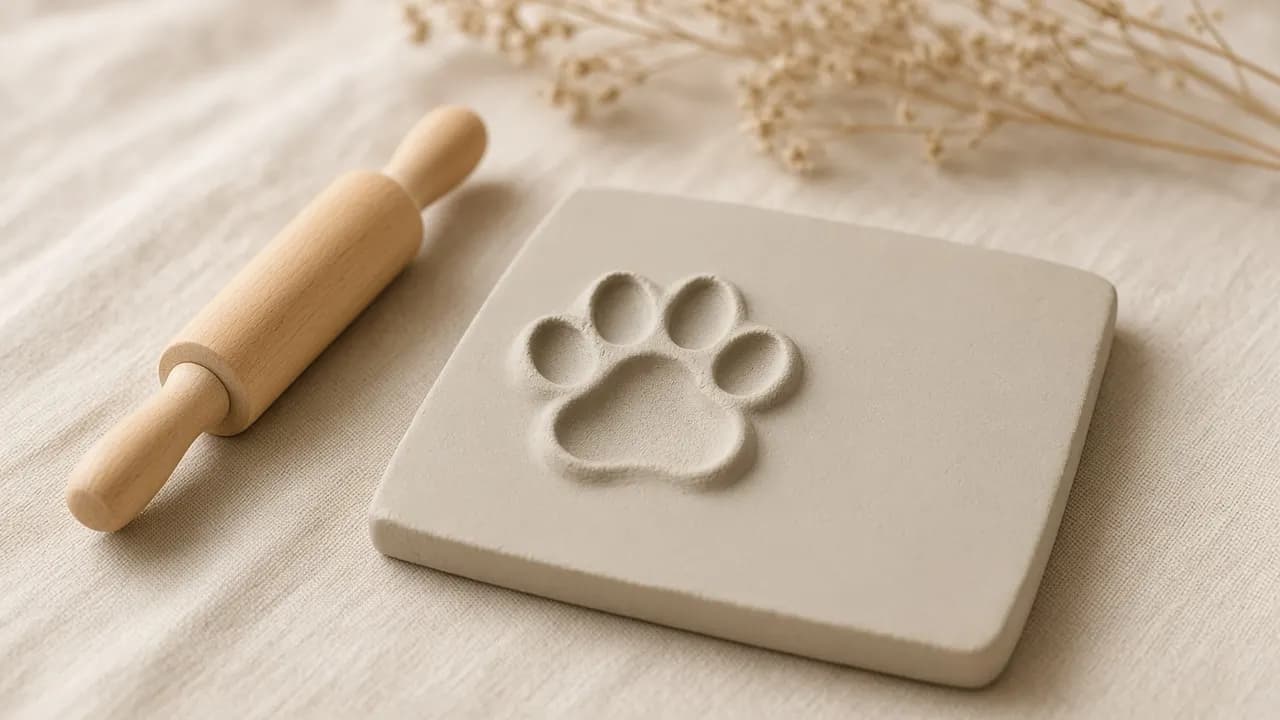
Use a kit sold for pet paw prints: pet-safe clay, non-toxic ink or an inkless wipe and paper. These are also sensible choices around small children. Skip the popular salt dough recipe. It's easy and cheap, but vets do see salt poisoning from it: the Merck Veterinary Manual's page on salt toxicosis names dough-salt mixtures as one cause, so it's dangerous to dogs if they lick or chew the drying print, and toddlers put things in their mouths too.
- Keep scissors for trimming paw fur with an adult only, and use blunt-tipped ones.
- Put drying clay on a high shelf, away from pets, toddlers and radiators.
- Have a damp cloth and a towel ready before you start, not halfway through.
- Wash hands, and paws, as soon as the print is done.
If you're unsure which kit suits your pet, the paw print kit chooser takes about thirty seconds. For the full method, see how to make a clay paw print at home.
Free tool
Paw print keepsake chooser
Match a print method to your pet's size, fur and the keepsake you want to keep.
What to say
How do you explain the print to a child?
Keep it honest and short. For a young child: "Biscuit is very old and his body is getting tired. We're going to press his paw into clay so we can always keep his paw print." For an older child you can add more: that the vet will help the pet die peacefully, and that the print is something the family will keep afterwards.
Avoid "put to sleep" with young children, who may become afraid of bedtime. Also avoid promising that the print will make everyone feel better. Grief after a pet surprises adults too: 66.9%[5] of RSPCA survey respondents were surprised by how intense it was. Children do better when they hear that sad is normal and that the print is a way to remember, not a way to stop missing someone. The Child Mind Institute's guide to helping children deal with grief makes the same case for plain words over euphemisms.
A child who helped make the print will often be the one who knows exactly where it's kept, years later.
Afterwards
What happens to the print afterwards, and who keeps it?
Decide this before the session if you can, because siblings notice fairness. One clay disc can't be split, but an ink or inkless print can be scanned and reproduced, so each child can have their own copy for their bedroom. Some families make one print per child in the same session instead.
If children also want a little of the ashes, in a keepsake urn or a pendant, the ashes sharing planner works out how far one pet's ashes will go. Our article on paw print keepsakes for families with kids has ideas for each age, and our services page lists who can make copies.
Grief can also be hard to show. 57.1%[6] of adults in the same survey felt they had to hide their grief, and children copy what they see. Letting them watch you touch the print and say the pet's name is a quiet way of showing that missing someone is allowed. If you'd like help finding print kits or local makers, send us a note. Our local pages list options by city.

Free tool
Ashes sharing planner
Split ashes fairly between family members, keepsake urns and jewelry.

Reader polls
What would you choose?
Vote anonymously and see how other readers answered. The results are live counts from people who visit this site, so they show real opinions, not a scientific sample.
How many copies of the print would your family want?
Tap an answer to vote and see how others answered. Anonymous.
What worries you most about taking a print yourself?
Tap an answer to vote and see how others answered. Anonymous.
What was the hardest part of losing your pet?
Tap an answer to vote and see how others answered. Anonymous.

Questions people ask
What age can a child help make a paw print?
Toddlers can join in by pressing their own hand into spare clay or patting the pet, while children from about eight can help steady the pet or write the name and date. Teenagers can often take the print themselves with an adult beside them. Watch your child rather than the calendar: interest and calm matter more than age.
Is salt dough safe for a paw print if children are helping?
It's safer to skip it. Salt dough is a common kids' craft recipe, but the high salt content can make dogs seriously ill if they lick or chew the drying print, and young children may taste it too. A pet-safe clay kit, non-toxic ink or an inkless wipe and paper is a safer choice for the whole family.
Should my child be there when the vet takes the print after euthanasia?
Only if they ask and you feel they're ready. Explain beforehand that the pet will be still, cool and wrapped in a blanket, keep the visit short and let them leave whenever they want. Many families prefer to have the print taken privately and let children join in afterwards by decorating or naming it.
How can each child have their own copy of one paw print?
Take an ink or inkless print, then scan or photograph it flat in good daylight. From that file you can print framed copies, order engraved tags or have pendants made for each child. Clay discs can't be divided, so if everyone wants a 3D print, press several discs in the same session.
What if my child doesn't want to be involved?
That's a completely valid choice and worth respecting. Let them know the print will be kept somewhere they can see it whenever they like, and that they can help decorate or name it later if they change their mind. Some children come back to the print months afterwards, once the first shock has passed.


Sources and our estimates
- [1] 93.4% of parents in the RSPCA survey wanted better guidance on helping children through pet loss. RSPCA — Pet Loss Survey Results, 2026.
- [2] In the RSPCA's pet-loss survey (over 4,000 respondents), 99.3% saw their pet as family, a friend or a companion. RSPCA — Pet Loss Survey Results, 2026.
- [3] About 7 in every 100 UK adults may have had a pet's death hit harder than any human loss. Our estimate: 32.6% have lost a pet x 21% chose pet as most distressing. How we calculate.
- [4] 75.4% of RSPCA pet-loss survey respondents experienced anticipatory grief before their pet died. RSPCA — Pet Loss Survey Results, 2026.
- [5] 66.9% of respondents were surprised by how intense their grief was after losing a pet. RSPCA — Pet Loss Survey Results, 2026.
- [6] 57.1% felt they had to hide their grief after a pet died, and 57.8% perceive stigma around pet loss. RSPCA — Pet Loss Survey Results, 2026.
Find print kits and helpers near you
Tell us what you need and where you are. We'll reply by email with clear options and prices so you can decide in your own time.