Clay, ink, metal or glass: which paw print format suits your keepsake?
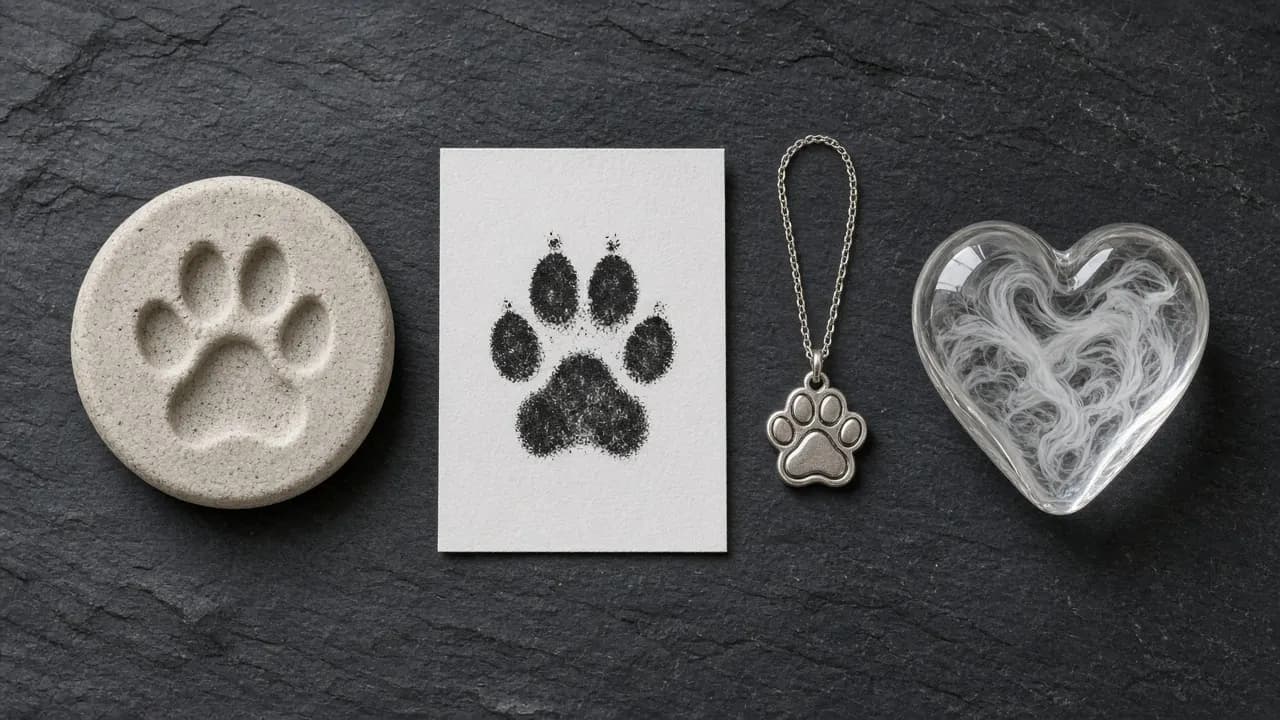
Clay captures depth, ink captures detail, and metal or glass turns either one into something you can wear or display for generations. Most families start with an ink or clay original, then have it copied into metal or glass later; one US cremation network charges $49–$133[1] for prints from plain ink to framed clay.
By the Paw Print Keepsakes & Memorial Impressions editorial team · Updated September 24, 2026 · 5 min read · Sources
- How each material looks after five, ten and twenty years
- Which formats need the pet present, and which work from a scan
- Real prices from US and UK makers
The quick comparison
Which paw print material should you choose?
Choose clay if you want to hold the paw's shape in your hand, ink if you want a crisp flat image that can be copied into anything later, and metal or glass when you want the print to be worn or to survive decades on display. Only clay, ink, inkless paper and casting molds need your pet present. Metal and glass are almost always made afterwards, from an original print or a good scan.
That split matters. If time is short, capture an ink or inkless print first, because it's quick and it's the format engravers and jewelers work from. Clay is lovely to have too, but a flat print is the one that unlocks every other option. Which format do other readers pick? The poll results keep a running tally.
| Format | Needs your pet present? | Detail | Lifespan with care | Typical use |
|---|---|---|---|---|
| Air-dry clay | Yes | Pad shape, some toe detail | Years; fragile if dropped | Shelf keepsake, shadow box |
| Oven-bake or kiln-fired clay | Yes, or a studio fires your impression | Good depth | Decades | Ornament, plaque, wall tile |
| Ink or inkless print | Yes | Fine lines and outline | Decades on acid-free card | Framing, and the source for copies |
| Engraved or cast metal | No, made from a print | Depends on the source | Generations | Pendant, tag, charm, bracelet |
| Glass (etched or with ashes) | No, made from a print or ashes | Softer, artistic | Generations if not knocked | Paperweight, bead, ornament |
If you could keep one kind of print from your pet, which would it be?
Tap an answer to vote and see how others answered. Anonymous.
Clay
How does clay compare, and why do some clay prints crack?
Clay's appeal is the third dimension: the dip of each pad, the pressure of the paw, sometimes a toenail mark. Home kits mostly use air-dry clay, which is soft to press and needs no oven. It stays slightly fragile for life, though, and it can crack if it dries too fast near a heater. Oven-bake polymer clay is sturdier once cured, and kiln-fired ceramic, which a studio makes from your impression, is the most durable of all.
Studio ceramic takes longer and costs more. A Canadian studio charges from CA$155[2] for a handmade ceramic paw-print keepsake and asks buyers to allow three to four weeks. By contrast, clay prints taken at a crematory are usually simple air-dry discs; one Northeast US network charges $76 for a clay or silver-clay print and $111 framed[1].
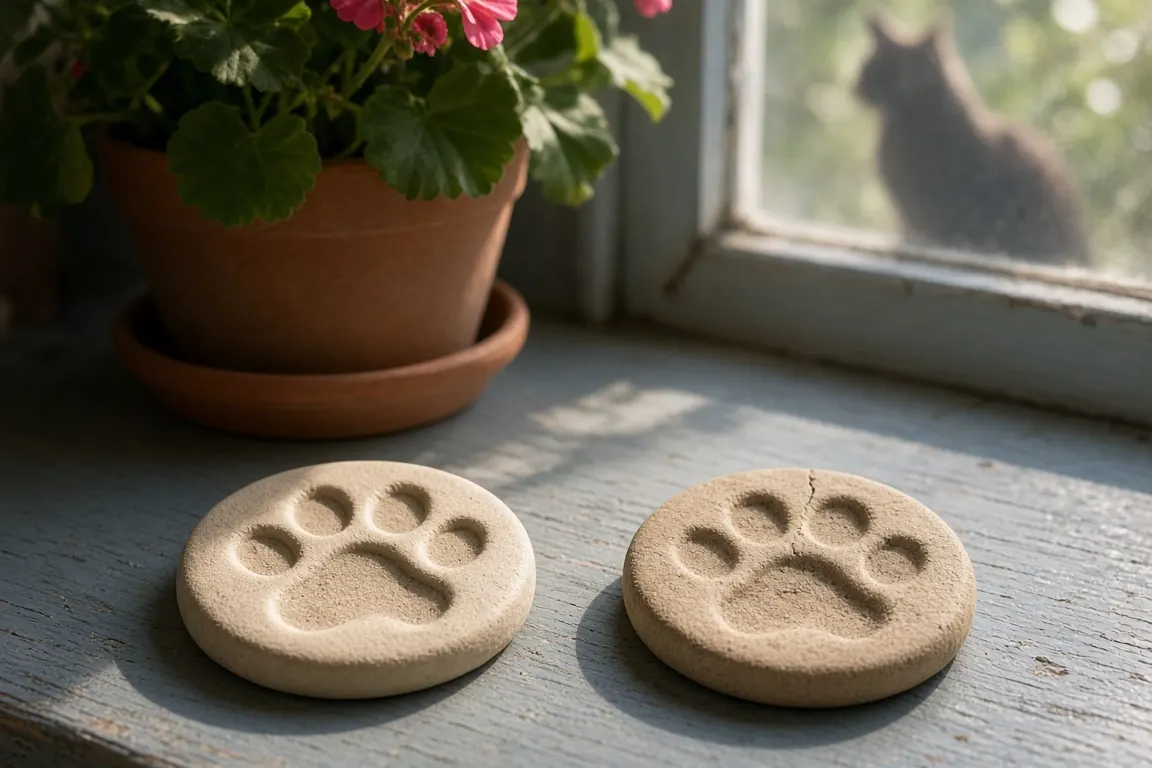
The detail you get from clay depends more on the paw than the brand. Big, flat dog pads print well. Small cat paws and furry rabbit feet press shallow, so a very soft clay and a thin disc help. Our paw print kit chooser suggests a clay type for your pet's size and fur.
Ink and inkless
Why is a flat ink print the most useful format?
An ink print is two-dimensional, but it holds something clay often can't: sharp edges and, on a nose print, the fine ridge pattern. That's why ink or inkless prints are what engravers and jewelers ask for. A single sheet can be scanned once and reproduced as a pendant, a tag, a tattoo stencil or a print for each family member, while the original stays safe at home.
Pet-safe ink is quick but can smudge if the paw slides. Inkless kits use a treated wipe and special paper, so nothing wet touches the fur, which suits cats and anxious pets. Ink is also cheap to add on: the same Northeast network charges $49[1] for ink prints. If you buy ink separately, look for pet-safe labelling or the "Conforms to ASTM D-4236" statement used under the Consumer Product Safety Commission's art materials rules. On acid-free card, behind UV-filtering glass, an ink print should outlast most frames; the Library of Congress recommends the same acid-free materials and low light for any treasured paper. Our guide to caring for ink and clay prints explains the storage details.
Free tool
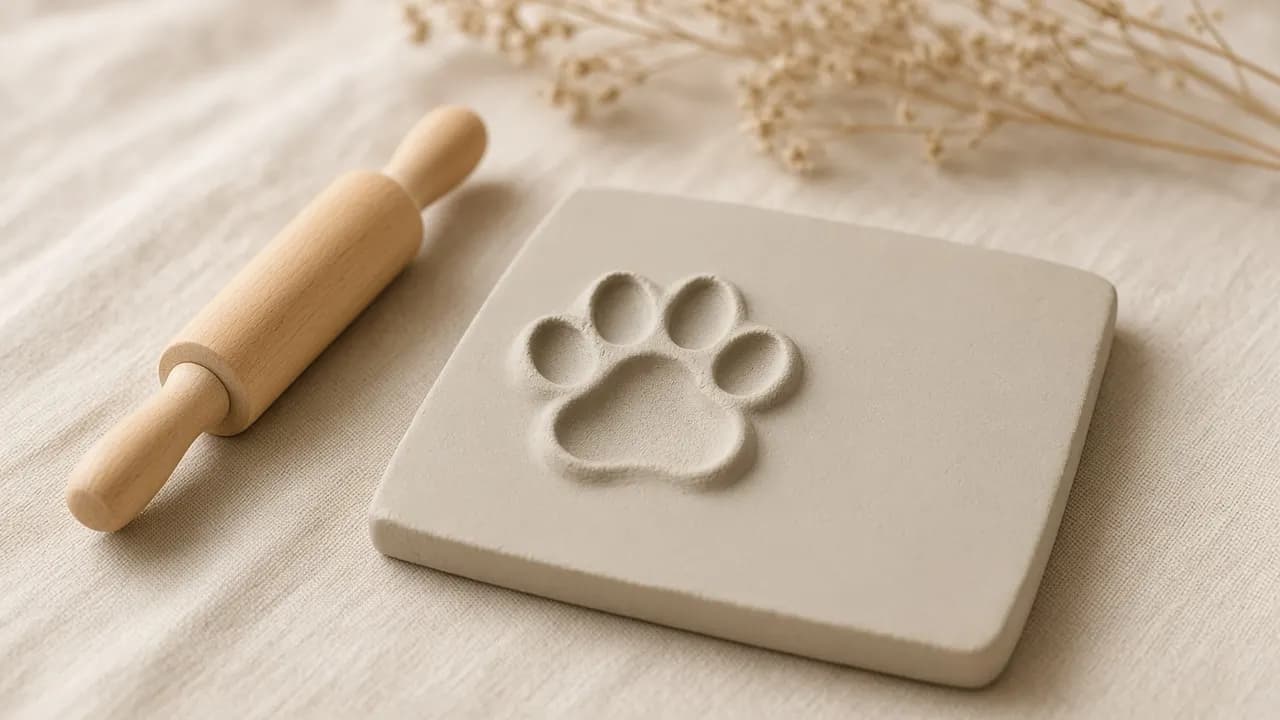
Paw print keepsake chooser
Match a print method to your pet's size, fur and the keepsake you want to keep.
Metal
What does it cost to turn a paw print into metal?
Metal is where a print becomes something you wear every day. There are three main routes, and they differ a lot in price.
- Engraving on a ready-made piece. A laser traces your scanned print onto a tag, pendant or urn plate. One urn retailer says adding an engraved paw print or symbol to a pet urn typically costs $20–$35[3], and paw and nose print pendants at one large retailer start from $99.95[4].
- Casting from the print. A jeweler uses your flat print to make a raised, custom charm. One maker charges $143[5] for a custom sterling silver actual-paw-print charm, before the chain, and takes about two weeks.
- Silver clay. Some crematories and makers press the paw straight into precious-metal clay, which is fired into solid silver. It keeps real 3D detail but needs your pet present.
Solid silver ages gracefully with a little polishing, and gold barely changes. Plated pieces can wear through over years of daily contact, so ask what the base metal is. Some print pendants also hold a pinch of ashes; our jewelry ash capacity guide shows how little that takes. Gold costs far more than silver, too: by our calculation, entry-level solid 14k gold ash pendants cost ~15×[6] as much as entry-level sterling silver ones at the same retailer.
Free tool
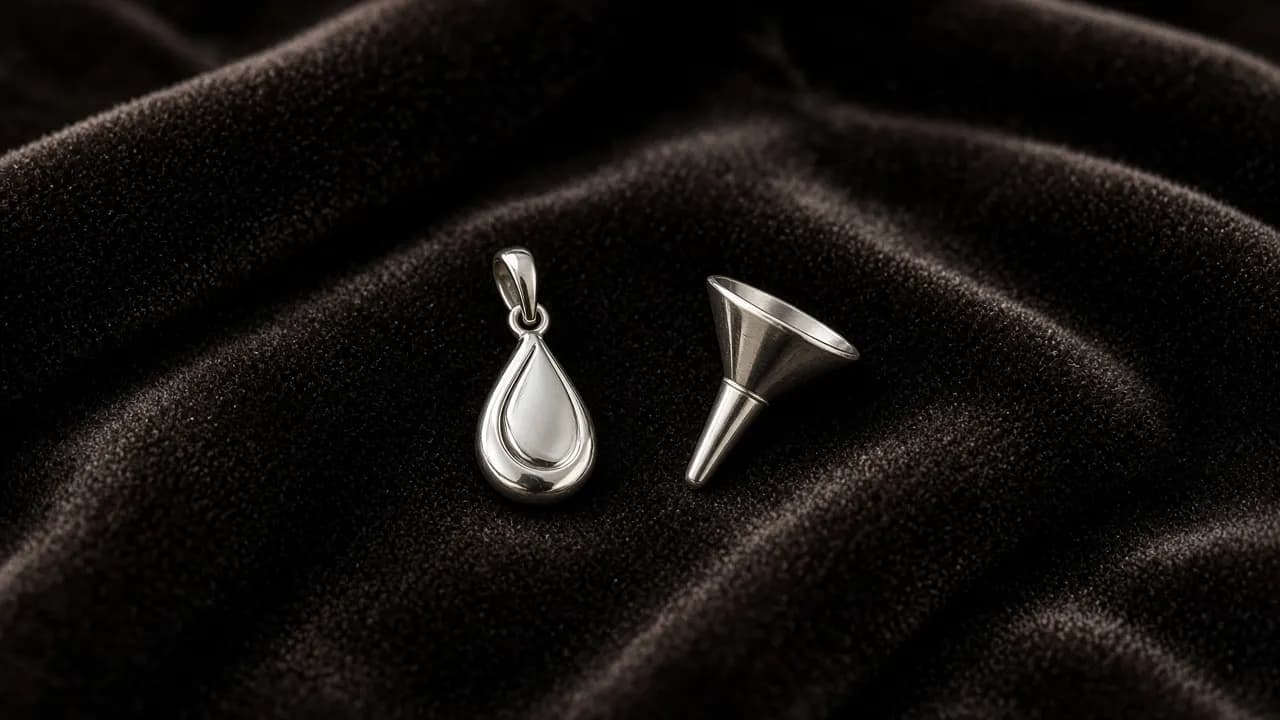
Jewelry ash capacity guide
How much ash fits in pendants, rings and glass, and how many pieces one pet can fill.
Glass
How do glass paw print keepsakes work?
Glass keepsakes come in two families. Etched glass carries your print as a frosted image on a panel, ornament or tumbler, made from a scan. Ashes-in-glass pieces swirl a tiny amount of cremated remains into a bead, pendant or paperweight, often with a paw motif set into the design rather than your pet's actual print.
The ash needed is very small: one US guide says glass studios use 1/8–1/2 tsp[7] of ashes per piece and typically ship 2–8 weeks[8] after receiving them. In England, one glassmaker charges £170[9] for a pet-ashes glass pendant. Glass lasts indefinitely unless it's dropped, so it suits a shelf or a windowsill more than a keyring.
1/8–1/2 tsp[7]
How to decide
Which format fits your family and your budget?
Start with how the keepsake will be used. If it will sit on a shelf, clay or glass. If it will hang on a wall, framed ink or a fired tile. If someone wants to wear it, metal, made from an ink print. If several relatives each want something, one ink original can be copied as often as you like, and the memorial budget planner helps you see what several pieces add up to.
Taste matters as much as durability. Interest in individual touches is widespread: 51% of pet owners in one market report said they were interested in personalized memorials[10]. Whatever you choose, keep the original somewhere dark and dry, and keep a scan somewhere safe. For framing ideas and pairing prints with engraved tags, see displaying prints and tags, and our services page lists who can make each format.
The original print is the hard part to get. Everything else, from silver to glass, can be made from it later.
If you're not sure who near you offers kiln-fired clay, silver clay or casting, tell us what you're after and we'll reply by email with options. Our local pages are organised by city if you'd like to look first.

Reader polls
What would you choose?
Vote anonymously and see how other readers answered. The results are live counts from people who visit this site, so they show real opinions, not a scientific sample.
If you could keep one kind of print from your pet, which would it be?
Tap an answer to vote and see how others answered. Anonymous.
Which memorial feels most like your pet?
Tap an answer to vote and see how others answered. Anonymous.
How much would you spend on a memorial item, beyond the cremation itself?
Tap an answer to vote and see how others answered. Anonymous.

Questions people ask
Which paw print material lasts the longest?
Metal and glass last longest, followed by kiln-fired ceramic. Ink on acid-free card also lasts for decades if it's framed behind UV-filtering glass and kept out of damp. Air-dry clay is the most fragile: it can crack if it dries too quickly or chip if dropped, so seal it and keep it out of direct sun and away from radiators.
Can I turn a clay paw print into metal later?
Often, yes. A jeweler or foundry can take a mold from a clay impression and cast it in silver, bronze or resin, keeping the 3D shape. A flat ink print is simpler for engraving, while clay suits casting. Ask the maker which they prefer before you send anything, and send a copy or a scan rather than your only original whenever you can.
Is ink safe for my pet's paws?
Use ink sold as pet-safe or non-toxic, and wipe the paw clean straight afterwards so your pet doesn't lick it off. Inkless kits avoid the problem altogether because the color develops on special paper, not on the fur. Avoid craft paints, markers and anything solvent-based, and keep cats in particular from grooming inky paws.
Why does a nose print usually come out better in ink than in clay?
A nose print's appeal is its fine ridge pattern, which is shallow and gets lost in clay. A light touch of ink or an inkless wipe records those lines clearly on flat card. That flat image is also exactly what jewelers need to engrave a nose print onto a pendant or tag.
How much does a paw print keepsake cost?
A simple ink or clay print taken at a crematory often costs between about $10 and $76, and by our estimate the median US add-on is around $32. Framed clay prints cost more, custom silver charms around $143 before the chain, and ashes-in-glass or ceramic studio pieces sit between. Home kits are another option if you'd like to take it yourself.


Sources and our estimates
- [1] Final Gift charges $49 for ink paw prints, $76 for a clay or silver-clay paw print, $111 framed, and $133 framed with a fur clipping; a fur clipping alone costs $23. Final Gift Pet Memorial Center – Memorial Products, 2026.
- [2] Spawts, a Canadian studio, charges from CA$155 for a handmade ceramic paw-print keepsake and asks buyers to allow 3–4 weeks. Spawts – Ceramic keepsakes, 2026.
- [3] Adding an engraved paw print or symbol to a pet urn typically costs $20–$35. Memorials.com – Pet Urn Cost Guide, 2025.
- [4] Paw print and nose print pendants at Memorials.com start at $99.95. Memorials.com – Pet print jewelry, 2026.
- [5] A custom sterling silver actual-paw-print charm costs $143 before the chain (about $59–$79 for silver) and takes about 2 weeks to make. String of Jewels – Actual paw print necklace, 2026.
- [6] Entry-level solid 14k gold pet-ash pendants cost about 15 times entry-level sterling silver ones at the same retailer. Our estimate: $1,297.95 / $87.95 (Memorials.com starting prices). How we calculate.
- [7] Ashes-in-glass pet memorials use only about 1/8 to 1/2 teaspoon of ashes. Funeral.com – Ashes in Glass for Pets, 2026.
- [8] Ashes-in-glass studios typically ship pieces 2–8 weeks after receiving the ashes. Funeral.com – Ashes in Glass for Pets, 2026.
- [9] Bath Aqua Glass in England charges £170 for a pet-ashes glass pendant and £195–£240 for a pet-ashes paperweight. Bath Aqua Glass – Pets ashes into glass, 2026.
- [10] Astute Analytica reports 51% of pet owners are interested in personalized memorials and 70% consider memorialization significant. Astute Analytica via GlobeNewswire — Global Pet Preservation Services Market to Hit USD 112.7 Million by 2032 (Apr 2, 2024), 2024.
Get print and keepsake options near you
Tell us what you need and where you are. We'll reply by email with clear options and prices so you can decide in your own time.